English
 Hindi (हिंदी)
 Gujarati (ગુજરાતી)
 Telugu (తెలుగు)
 Marathi (मराठी)
 Bengali (বাঙ্গালী)
 Turkish
 Dutch
 Italiano
 Russian
 Romaian
 Portuguese (Brazil)
 Greek
 Arabic
 French
 Deutsch
 Spanish
 Portuguese


ChatGPT Plagiarism Checker — AI & Similarity Detection for Dissertations:
I remember the exact moment I realised AI detection was going to be a problem. I was sitting in a university library, watching a friend rewrite her dissertation introduction for the third time in two days. She had not plagiarised anything. She had not even used ChatGPT. But Turnitin had flagged her work as "AI-generated" with a confidence score that made her supervisor raise an eyebrow. She was terrified. She had spent months on her research, and now she was being asked to prove that her own words were her own. That feeling of being accused of something you did not do, of having your integrity questioned by an algorithm, is one of the most stressful experiences a student can face. And it is becoming more common every single year.
If you are in that situation, or if you are simply trying to make sure your work is clean before you submit, Premier Dissertations has a dedicated guide on ChatGPT plagiarism and AI detection for dissertations. You can read it here: https://premierdissertations.com/chatgpt-dissertation-plagiarism/. It explains how AI detectors work, why they sometimes flag human writing, and what you can do to protect yourself before submission.
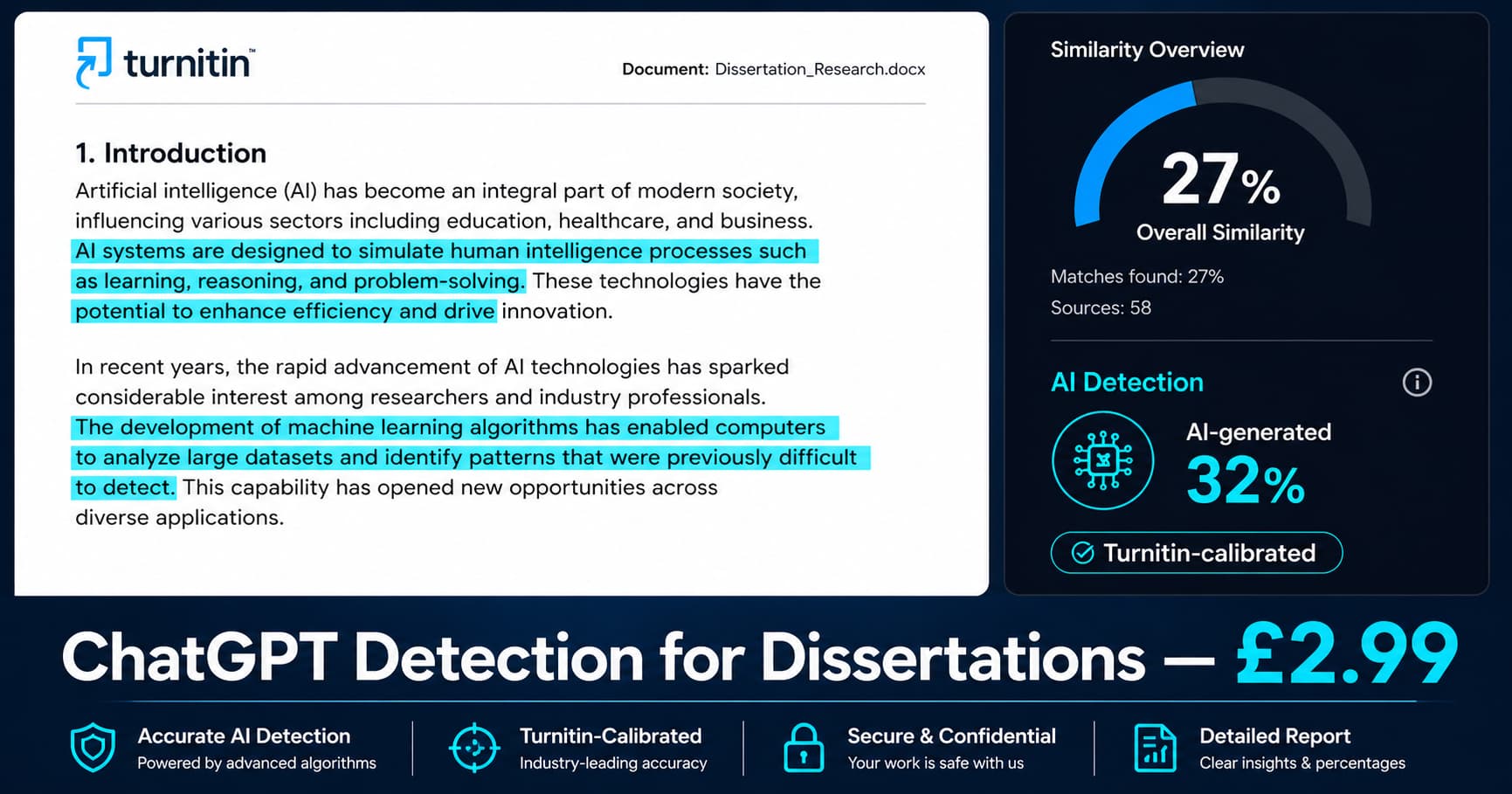
The first thing to understand is that plagiarism and AI detection are not the same thing, even though they often get lumped together. Plagiarism is about using someone else's words or ideas without attribution. AI detection is about identifying patterns that are statistically more likely to be produced by a large language model than by a human. A ChatGPT plagiarism checker typically combines both functions. It checks your work against a database of existing sources for similarity, and it analyses your writing style for signs of AI generation. These are two different technologies, and they can produce two very different results.
Similarity detection is the older, more established technology. It works by comparing your text against billions of web pages, academic papers, and other documents. If it finds a match, it highlights it and gives you a percentage score. This is what Turnitin has been doing for decades. The score itself is not a judgment. A high similarity score might simply mean that you have quoted extensively, or that you are writing about a common topic using standard terminology. What matters is whether the matching text is properly cited. If it is, you are fine. If it is not, you have a problem. But the algorithm does not know the difference. It just reports the match.
The most important thing to remember is that you are not alone in this. Every student is navigating the same uncertainty. The rules are changing. The technology is evolving. And the pressure to get it right is enormous. But if you approach your work with integrity, keep good records, and seek help when you need it, you will be fine. The goal is not to beat the detector. The goal is to produce work that is genuinely yours, and to be able to prove it. That is something no algorithm can take away from you.
ChatGPT Plagiarism Checker — AI & Similarity Detection for Dissertations:
I remember the exact moment I realised AI detection was going to be a problem. I was sitting in a university library, watching a friend rewrite her dissertation introduction for the third time in two days. She had not plagiarised anything. She had not even used ChatGPT. But Turnitin had flagged her work as "AI-generated" with a confidence score that made her supervisor raise an eyebrow. She was terrified. She had spent months on her research, and now she was being asked to prove that her own words were her own. That feeling of being accused of something you did not do, of having your integrity questioned by an algorithm, is one of the most stressful experiences a student can face. And it is becoming more common every single year.
If you are in that situation, or if you are simply trying to make sure your work is clean before you submit, Premier Dissertations has a dedicated guide on ChatGPT plagiarism and AI detection for dissertations. You can read it here: https://premierdissertations.com/chatgpt-dissertation-plagiarism/. It explains how AI detectors work, why they sometimes flag human writing, and what you can do to protect yourself before submission.
The first thing to understand is that plagiarism and AI detection are not the same thing, even though they often get lumped together. Plagiarism is about using someone else's words or ideas without attribution. AI detection is about identifying patterns that are statistically more likely to be produced by a large language model than by a human. A ChatGPT plagiarism checker typically combines both functions. It checks your work against a database of existing sources for similarity, and it analyses your writing style for signs of AI generation. These are two different technologies, and they can produce two very different results.
Similarity detection is the older, more established technology. It works by comparing your text against billions of web pages, academic papers, and other documents. If it finds a match, it highlights it and gives you a percentage score. This is what Turnitin has been doing for decades. The score itself is not a judgment. A high similarity score might simply mean that you have quoted extensively, or that you are writing about a common topic using standard terminology. What matters is whether the matching text is properly cited. If it is, you are fine. If it is not, you have a problem. But the algorithm does not know the difference. It just reports the match.
The most important thing to remember is that you are not alone in this. Every student is navigating the same uncertainty. The rules are changing. The technology is evolving. And the pressure to get it right is enormous. But if you approach your work with integrity, keep good records, and seek help when you need it, you will be fine. The goal is not to beat the detector. The goal is to produce work that is genuinely yours, and to be able to prove it. That is something no algorithm can take away from you.

·10χλμ. Views
·0 Προεπισκόπηση