English
 Hindi (हिंदी)
 Gujarati (ગુજરાતી)
 Telugu (తెలుగు)
 Marathi (मराठी)
 Bengali (বাঙ্গালী)
 Turkish
 Dutch
 Italiano
 Russian
 Romaian
 Portuguese (Brazil)
 Greek
 Arabic
 French
 Deutsch
 Spanish
 Portuguese

Broncos feel robbed on fourth-down spot by refs that cost 3 point
Shopping |
2026-10-30 02:26:10
The global mineral water industry stands at a pivotal juncture. Over the past half-decade, market participants have navigated supply chain realignments, evolving consumer preferences, and a tightening regulatory landscape that spans continents. As organizations prepare their strategic roadmaps for the remainder of the decade, the need for rigorous, forward-looking intelligence has never been more acute. PW Consulting’s latest market research study delivers exactly that: a comprehensive, data-rich examination of the mineral water sector across its historical trajectory and projected growth window. This article outlines the strategic value of the study, previews its operational structure, and demonstrates how executives, investors, and category managers can leverage its insights to sharpen competitive positioning in 2026 and beyond.
Worldwide KN Series Melt Blown Fabrics Market
Any credible strategic assessment begins with a clear understanding of market scale and momentum. The mineral water sector has demonstrated resilient expansion through a period marked by inflationary pressures, logistical friction, and shifting retail architectures. Total market revenue crossed the 6.6 billion USD threshold in 2025, building on a foundation laid throughout the 2020 to 2025 historical window. While annual fluctuations reflect the ordinary cadence of commodity cycles and regional demand variations, the overarching narrative is one of sustained upward movement.
Short-video Editing Software Market
Looking ahead, the forecast period spanning 2026 through 2032 projects a compound annual growth rate of 3.2 percent. That trajectory translates into a market size approaching 8.2 billion USD by the close of the forecast horizon. These figures, while compelling on their own, gain strategic meaning only when contextualized against the structural forces shaping category consumption, distribution efficiency, and competitive intensity. Market leaders cannot afford to treat growth as a passive outcome; it must be engineered through deliberate investment in capacity, brand architecture, and channel optimization. The study’s quantitative framework provides the baseline necessary to pressure-test assumptions, calibrate production planning, and align capital allocation with realistic demand scenarios.
Sound Suppressed Hydraulic Hammers Market
Equally important is the market’s concentration profile. The top three players collectively account for 28.5 percent of total industry revenue, while the top five represent 32.7 percent. This moderate concentration signals a sector that remains accessible to agile entrants and regional specialists, yet increasingly dominated by multinational incumbents with the scale to drive procurement savings, accelerate distribution coverage, and invest in premium brand differentiation. Understanding where concentration is building—and where whitespace still exists—forms a central pillar of the report’s competitive analysis.
The research is structured to move beyond descriptive market sizing and into the operational territory where strategy meets execution. Executives who rely on high-level summaries often miss the granular dynamics that determine whether a market entry succeeds, a product line expands profitably, or a supply disruption becomes a strategic liability. This study is built to close that gap.
At its core, the report delivers a multi-dimensional segmentation architecture that maps demand across consumer channels, product classifications, and geographic zones. Rather than presenting isolated snapshots, the analysis traces how these dimensions interact. For example, the dominance of hypermarkets and supermarkets as a distribution channel is examined alongside the steady rise of convenience retail and the accelerating, if still measured, contribution of e-commerce. Each channel is evaluated through the lens of margin structure, shelf-space competition, logistical requirements, and consumer purchase behavior. Readers will gain a clear view of where volume concentrates, where premiumization is gaining traction, and which format transitions are reshaping category economics.
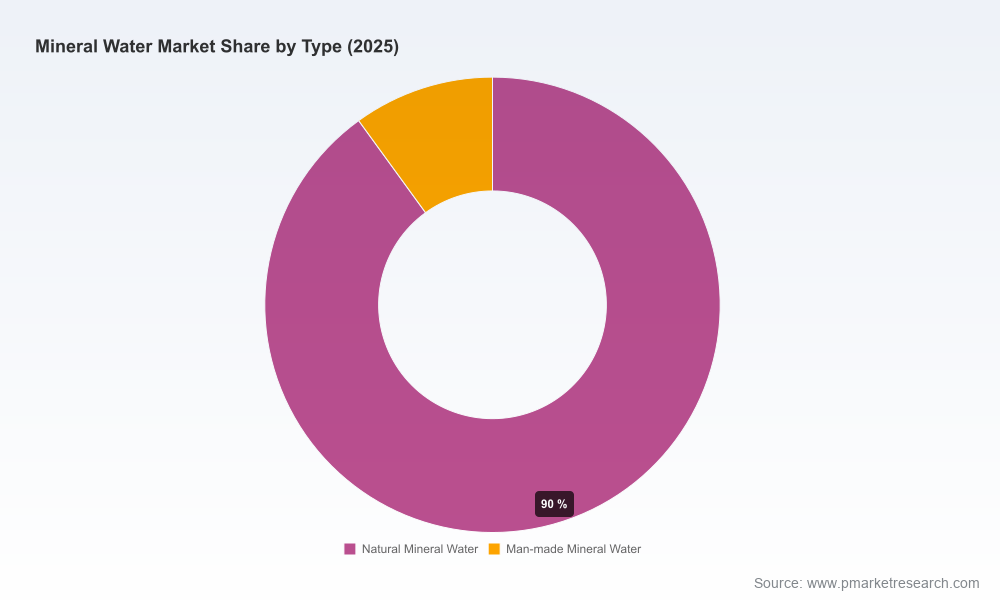
The product typology dimension is treated with equal rigor. The study distinguishes between natural mineral water and man-made mineral water, not simply as categories, but as strategic pathways with different sourcing constraints, regulatory obligations, and consumer perception profiles. Natural mineral water continues to command the bulk of category revenue, reflecting longstanding trust in terroir-driven branding and perceived purity. Yet the man-made segment carries its own strategic logic, particularly where source availability is constrained or where formulation flexibility supports targeted functional positioning. The report evaluates how each type performs across channels and regions, enabling stakeholders to assess whether their portfolio mix aligns with end-market expectations.
Beyond segmentation, the study incorporates forward-looking demand modeling that accounts for demographic shifts, wellness trends, and retail modernization. The forecast framework does not merely extrapolate past growth; it tests how changes in disposable income, urbanization patterns, and on-the-go consumption habits might alter velocity across different markets. This allows users to build scenario-based plans rather than relying on a single point estimate.
No mineral water strategy is complete without an unvarnished assessment of the companies that define the competitive baseline. The report profiles the organizations that hold disproportionate influence over brand perception, distribution breadth, and production capability. These include Danone, whose portfolio anchored in Evian and Volvic underscores a commitment to natural mineral water offerings; Nestlé Waters, which manages a globally recognized roster including Perrier, San Pellegrino, Acqua Panna, and Vittel; The Coca-Cola Company, leveraging the Topo Chico brand to extend its sparkling and still water presence; Fiji Water Company, maintaining a premium positioning around its signature Fiji brand; and Gerolsteiner Brunnen GmbH & Co. KG, whose Gerolsteiner Sprudel and Gerolsteiner Naturell lines reinforce its standing in the European market.
What separates this analysis from a static company directory is its treatment of recent corporate and operational events as strategic signals. The mineral water sector is not evolving in a vacuum; it is being reshaped by portfolio restructuring, production continuity decisions, and certification achievements that speak directly to operational resilience and sustainability positioning.
The separation of Nestlé’s water and premium beverages activities into a standalone business, effective from the start of 2025, marked a decisive pivot in how one of the world’s largest food and beverage groups manages its water portfolio. That restructuring set the stage for a formal sale process for the standalone water business, valued at approximately 5 billion EUR and encompassing core mineral water brands. For competitors, channel partners, and prospective acquirers, this transaction context is more than a corporate headline. It signals potential shifts in ownership concentration, renegotiation of supply and distribution relationships, and the possible recalibration of brand investment priorities. The study examines the implications of this process for market structure and competitive dynamics without speculating beyond the available evidence.
Coca-Cola’s recent operational developments around its Topo Chico line similarly illustrate the kind of event-driven intelligence the report integrates into its strategic narrative. A voluntary recall of limited quantities of carbonated Topo Chico in 16.9-ounce glass bottles, initiated over potential bacterial contamination concerns, highlighted the operational and reputational sensitivities that accompany bottled water production. More recently, the company paused production of Topo Chico mineral water in the United States to carry out facility upgrades at its source and manufacturing site in Mexico, with product expected to return to shelves later in 2026. For stakeholders monitoring category availability, these events underscore the importance of supply continuity planning, quality assurance visibility, and communication discipline during production interruptions. The study places such developments in context, showing how they affect short-term channel dynamics and long-term brand equity management.
Operational standards also feature prominently in the competitive picture. Certification milestones, such as the AWS Standard v2.0 certification received by a Nestlé Waters facility in Vietnam, reflect the growing importance of water stewardship as a differentiator and a compliance expectation. In markets where resource management, community relations, and environmental accountability increasingly influence procurement decisions and consumer trust, such certifications are not peripheral achievements; they are strategic assets. The report maps how stewardship credentials intersect with brand positioning and market access.
Regulatory evolution is one of the most consequential forces shaping the mineral water sector, and it is an area where strategic foresight can translate directly into risk mitigation. The study incorporates a cross-section of recent regulatory and standards-related developments that are altering how producers formulate, label, test, and distribute their products.
In Europe, the European Union amendment regulations published by the Irish Ministry of Health in mid-2025 introduced updated definitions for water samples, clarified market entry conditions, and refined officials’ sampling procedures. While regulatory language may appear technical, its downstream effects touch product documentation, laboratory protocols, inspector coordination, and the pace at which new SKUs or regional launches can be executed. A producer that underestimates these administrative and procedural shifts can face delays that ripple into shelf availability and promotional calendars.
In Asia, Japan’s Consumer Affairs Agency proposed combined limits of 50 ng/L for PFOS and PFOA in sterilized or disinfected mineral water products, aligning bottled water standards more closely with tap water thresholds. As public attention to persistent environmental contaminants intensifies, parameter limits of this kind increasingly influence consumer confidence and may become a factor in retailer procurement criteria. The study evaluates how such thresholds could affect testing burdens, sourcing decisions, and messaging strategies for brands competing on purity and safety.
Meanwhile, the United States continues to maintain mineral water standards that require at least 250 parts per million total dissolved solids from protected underground sources, with no added minerals. Although long-standing, this baseline remains a foundational reference point for product classification and labeling compliance, and any strategic plan involving product architecture or cross-border sourcing must account for it.
India’s regulatory trajectory introduces another layer of complexity. The Food Safety and Standards Authority of India removed mandatory BIS certification for packaged drinking water and mineral water effective in late 2024, replacing it with a new compulsory Scheme of Testing for source water, microbiological safety, packaging, and hygiene from the start of 2026. This transition moves compliance emphasis away from a single certification mark toward a broader testing and hygiene framework. For companies operating in or entering the Indian market, this shift alters the compliance roadmap, laboratory engagement priorities, and quality assurance cadence. The study treats such transitions as strategic inflection points, helping users anticipate operational adjustments before they become urgent.
Taken together, these regulatory developments illustrate a broader pattern: mineral water is increasingly subject to scrutiny that spans source protection, contaminant limits, sampling integrity, and stewardship accountability. The report’s dynamics section situates these changes within the competitive environment so that readers can identify which requirements will influence cost structures, which will affect speed to market, and which may open or close access to specific retail and export channels.
Strategic planning in the mineral water sector requires more than awareness of growth trends. It demands a clear footing on where demand is actually forming, how channel economics are shifting, which regulatory obligations will shape operations, and how competitors are repositioning themselves through portfolio changes and operational investments. The study is designed to serve as a decision-support instrument across several functional domains.
For corporate strategy teams, the report provides a structured basis for evaluating expansion opportunities, portfolio rationalization, and brand architecture choices. By linking segmentation data to channel and regional dynamics, it helps leaders determine whether to push deeper into existing formats, invest in emerging retail channels, or prioritize premiumization in specific consumer segments.
For supply chain and operations leaders, the analysis offers context on production continuity risks, sourcing constraints tied to natural source availability, and certification expectations that affect market access. The integration of recent operational events into the competitive narrative ensures that users can benchmark their own contingency planning and quality systems against industry realities.
For commercial and sales executives, the channel-level perspective supports more precise allocation of trade resources, shelf-coverage negotiations, and format-specific pricing strategies. Understanding where volume concentrates and how convenience retail, grocery, and e-commerce contribute to overall demand enables more targeted route-to-market planning.
For investors and M&A professionals, the ownership and transaction context surrounding major players provides a lens on potential consolidation pathways, brand valuation drivers, and the strategic logic behind portfolio separation or divestment. The market concentration data, combined with company-specific developments, offers a framework for assessing where competitive advantage is being built and where vulnerabilities may emerge.
Crucially, the study is built to be actionable rather than descriptive. It translates macro-level market sizing into a format that can inform budget assumptions, capacity decisions, compliance timelines, and brand investment priorities. By presenting segmentation, competition, and regulatory dynamics in an integrated manner, it helps users avoid the trap of analyzing each factor in isolation.
The summary presented here captures the strategic architecture and key themes of the study, but the complete research deliverable contains the depth required to convert insight into execution. The full report expands the segmentation analysis with detailed breakdowns across regions and applications, provides extended company profiles that connect strategic positioning to recent operational and corporate events, and offers a more granular view of the regulatory environment by market. It also sets out the forecast logic and scenario parameters that underpin the 2026 to 2032 projection window, enabling users to test how changes in consumption behavior, channel mix, or compliance costs could alter growth outcomes.
For organizations that need to move quickly in a sector where retail architecture, consumer expectations, and regulatory requirements are all in motion, that level of detail is not optional. It is the difference between a strategy built on surface-level trends and one grounded in validated market structure.
To access the complete segmentation tables, extended competitive profiles, regulatory mapping, and forecast detail, readers are encouraged to explore the full Mineral Water Market research release on the PW Consulting platform. The study is designed to function as a working intelligence asset for teams planning category investment, market entry, portfolio optimization, and risk management throughout 2026 and the years ahead.
For detailed analysis of this topic, please visit the official page:Mineral Water Market
Lacy Lee
Senior Marketing Manager
[email protected]
00852-95632430
PW Consulting: www.pmarketresearch.com