English
 Hindi (हिंदी)
 Gujarati (ગુજરાતી)
 Telugu (తెలుగు)
 Marathi (मराठी)
 Bengali (বাঙ্গালী)
 Turkish
 Dutch
 Italiano
 Russian
 Romaian
 Portuguese (Brazil)
 Greek
 Arabic
 French
 Deutsch
 Spanish
 Portuguese

Researching BidDynamic along with On the internet Sector Providers
Other |
2026-09-29 12:49:00
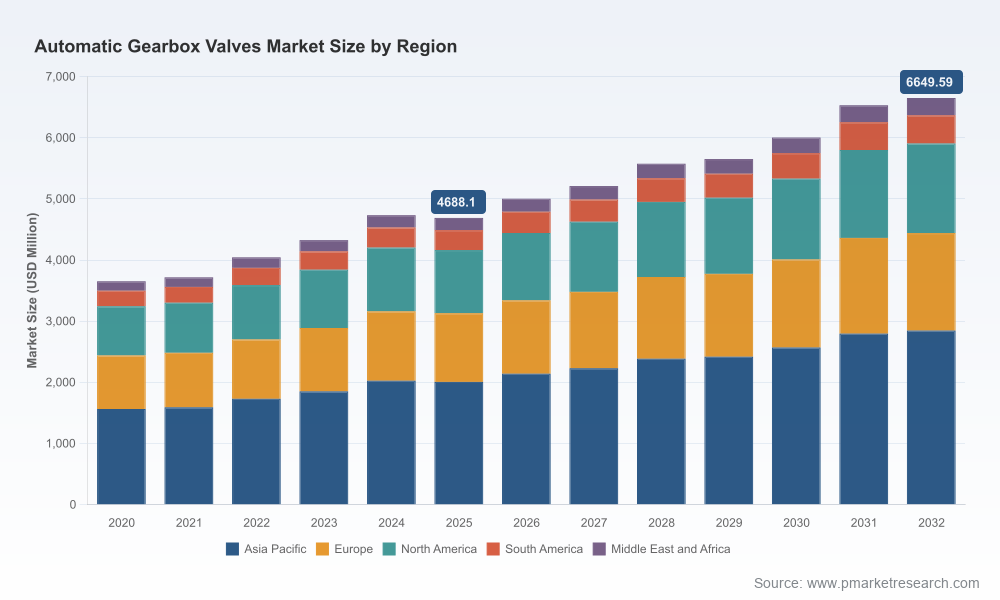
PW Consulting today releases a strategic industry briefing built on our new Worldwide Automatic Gearbox Valves Market research (base year 2025; historical window 2020–2025; forecast 2026–2032). The study synthesizes market sizing, supplier positioning, technology readiness, regulatory scenario workstreams and supply‑chain stress tests to equip executives with the decision-grade intelligence they need for 2026. At the macro level, the global market demonstrated steady expansion over the historical period and is projected to grow at a compound annual growth rate (CAGR) of 5.12% through 2032, rising from the mid‑four‑billion range in 2025 to an expected market scale approaching the high six‑billion range (USD Million) by the end of the forecast horizon.
Non-Contact Passive Sensor Market
Actionable foresight for capital allocation — Our scenario-driven forecasts convert macro growth into investment-ready implications for manufacturing capacity, R&D budgets and plant footprint decisions.
Card Grading Services Market
Procurement and sourcing optimization — The report maps supplier capabilities against OEM technical and quality requirements, enabling procurement to refine dual‑sourcing strategies and supplier development priorities without exposing commercially sensitive contract data in public forums.
Worldwide BPA Free Cans Market
M&A and partnership playbooks — With market concentration metrics and a behavioral read on Tier‑1s, the report prioritizes M&A targets, JV structures and integration risks for 2026 deal pipelines.
Regulatory compliance roadmaps — Our analysis translates new and emerging emissions and safety rules into specific valve functional requirements and testing protocols that OEMs and suppliers must factor into 2026 product roadmaps.
Rather than a static PDF of numbers, this briefing highlights the market’s structural momentum: steady historical growth from 2020 through 2025 and a projected continuation of expansion through 2032 at a 5.12% CAGR. Market concentration is notable but not extreme; the top three suppliers account for a meaningful plurality of industry revenues, while a wider set of five firms increases the concentration profile — a pattern that supports selective consolidation plays and targeted partnerships. These higher‑level metrics explain why 2026 is a pivotal year for bet‑making on product platforms and capacity reconfiguration.
Top‑down and bottom‑up market sizing validated across supply chain nodes, including OEM demand channels, aftermarket flows and export scenarios.
Scenario models (regulatory tightening, raw material shocks, EV/hybrid adoption rates) that quantify revenue, margin and unit‑mix outcomes under three planning horizons.
Supplier scorecards and heat maps: capability, quality, technological readiness, geographic footprint and program risk (ranked and benchmarked).
Technology adoption matrix that assesses maturity and adoption timelines for key innovations — electronic control integration, lightweight valve body designs, synthetic‑fluid compatibility and coatings for spool longevity.
M&A playbook with valuation sensitivities and integration checklists oriented toward 2026‑2028 deal windows.
Supply‑chain resilience simulations that stress‑test the impact of aluminum and specialty steel price swings, and propose hedging, inventory and nearshoring strategies.
Commercial models for OEM sourcing teams: total cost of ownership (TCO) by sourcing configuration, service level agreements, and warranty exposure scenarios tied to valve control failures.
Operational guidance for ramp planning, including recommended takt times, inspection regimes and capital investments for solenoid assembly and valve body machining lines.
The gearbox valve market blends legacy OEM suppliers, global Tier‑1 systems integrators and specialized solenoid manufacturers. The PW Consulting study profiles the competitive dynamics and strategic postures of the leading participants, including:
BorgWarner (Auburn Hills, Michigan, USA) — A dominant Tier‑1 in electro‑hydraulic solenoids and valve body assemblies, known for multi‑speed and hybrid transmission solutions that prioritize efficiency and shift quality.
Aisin Corporation (Kariya, Aichi, Japan) — Integrated transmission and valve supplier with deep OEM relationships and precision hydraulic control components embedded in high‑volume platforms.
ZF Friedrichshafen (Friedrichshafen, Germany) — Offers end‑to‑end transmission systems where valve and solenoid integration is optimized for electronic‑hydraulic control strategies.
Bosch GmbH (Gerlingen, Germany) — Leverages a broad electronics and hydraulics portfolio to supply pressure and shift solenoids as part of larger powertrain control systems.
TLX Technologies (Pewaukee, Wisconsin, USA) — Specialist in custom solenoid design, increasingly relevant as OEMs demand bespoke solutions for new vehicle architectures.
Magna Powertrain (Aurora, Ontario, Canada) — Integrates valve and control component offerings into holistic powertrain modules, a strategic advantage for OEMs seeking single‑source solutions.
HUSCO Automotive (Waukesha, Wisconsin, USA) — Focused on electro‑hydraulic solenoids, notable for recent capacity expansion to support shift‑by‑wire and start‑stop systems.
Hitachi Astemo, Mitsubishi Electric, and Parker Hannifin — Providers with complementary strengths in electronics, solenoid performance and fluid control system integration.
Our competitive profiles include capability gaps, pricing positioning, program wins/losses and an assessment of which vendors are most likely to pursue vertical integration versus partnership strategies. The aim: enable negotiation teams to convert tech and reliability attributes into contract leverage in 2026.
Capacity re‑balancing: A confirmed capacity expansion by a leading electro‑hydraulic valve manufacturer demonstrates rising OEM demand for shift‑by‑wire and start‑stop capable valve modules; firms that miss 2026 ramp windows risk losing program share.
Quality and litigation risks: A high‑profile recall linked to a transmission control valve defect underscores the cost of latent failure modes, and elevates supplier traceability, testing and warranty provisions to board‑level priority.
Cross‑sector technology transfer: Strategic partnerships that adapt precision solenoid advances (including zero‑emission electric valve actuation) from industrial to automotive domains are shortening innovation cycles.
Regulatory tailwinds: Stricter emissions regimes across major markets are a structural growth driver for electronically controlled valve bodies that enable optimized shift strategies and fuel‑efficiency gains.
Two strategic risk themes must be on every executive agenda in 2026: materials and function. Volatility in aluminum and specialty steel prices affects valve‑body manufacturing economics and may necessitate hedging or alternative material adoption. Functionally, the transition to electronically controlled valve bodies, enhanced solenoid diagnostics and the use of synthetic transmission fluids require investments in testing, coatings and supplier certification programs. PW Consulting’s report provides a prioritized, costed roadmap to mitigate both risk vectors.
OEMs: Update supplier qualification to include digital diagnostics capability, and require end‑to‑end traceability on critical valve subassemblies. Accelerate co‑engineering programs for lightweight valve bodies and fluid compatibility testing.
Tier‑1 suppliers: Fast‑track production automation where repeatability reduces warranty exposure; consider targeted capacity investments in regions aligned with OEM sourcing shifts.
Private equity and strategic investors: Screen targets using our supplier scorecards and concentration dynamics; prioritize add‑on plays that close capability gaps (electronics, diagnostics, coatings).
Aftermarket players: Prepare for tighter OEM controls by developing diagnostic service offerings and OEM‑grade refurbishing capabilities.
Policy and compliance teams: Use the report’s regulatory scenarios to prioritize pre‑compliance test programs for upcoming emissions and safety standards.
90 days — Immediate actions: supplier audits, targeted hedging of key raw materials, and initiation of quality‑forensics on mission‑critical components.
180 days — Tactical moves: finalize co‑engineering pacts, commit to capacity by program, and re‑align procurement frameworks around performance‑based SLAs.
360 days — Strategic shifts: evaluate M&A or JV transactions, implement design‑for‑manufacturing changes for next‑generation valve modules, and roll out digital condition monitoring across transmission lines.
The automatic gearbox valve market is entering a phase where regulatory pressure, powertrain diversity and technology convergence create both risk and opportunity. Market scale is expanding predictably, concentration patterns favor informed consolidation plays, and suppliers that combine electro‑hydraulic expertise with electronic control and materials know‑how will capture disproportionate value. PW Consulting’s Worldwide Automatic Gearbox Valves Market report translates these dynamics into executable priorities for 2026 and beyond — from procurement playbooks and plant investments to M&A strategies and compliance roadmaps.
To access the complete study — including granular regional and application segmentation, supplier rankings and the full set of scenario outputs and datasets — please visit our report page and download the executive pack. The public briefing intentionally omits those granular splits to preserve the actionable advantage the full report provides to subscribers and paying clients.
For detailed analysis of this topic, please visit the official page:Worldwide Automatic Gearbox Valves Market
Lacy Lee
Senior Marketing Manager
[email protected]
00852-95632430
PW Consulting: www.pmarketresearch.com